

- Website
- Get directions
- prev
- next
About
salt
The salt pans in the northern Adriatic had a great influence on the economies of the countries and city-states of the area for centuries. They were the subject of political disputes and wars, because salt was a valuable raw material and strategic merchandise, important for food preservation and for the production of gunpowder, due to its usefulness. Once upon a time, there were many smaller and larger salt pans in the Gulf of Trieste and Istria (e.g. in Milje, Koper, Izola, Lucia), but only Sečoveljske and Strunjanska have survived to this day. They were marked not only by political and economic interests, but also by the capriciousness of nature, which sometimes made salt production impossible for long periods, and at other times gave it an overabundance.
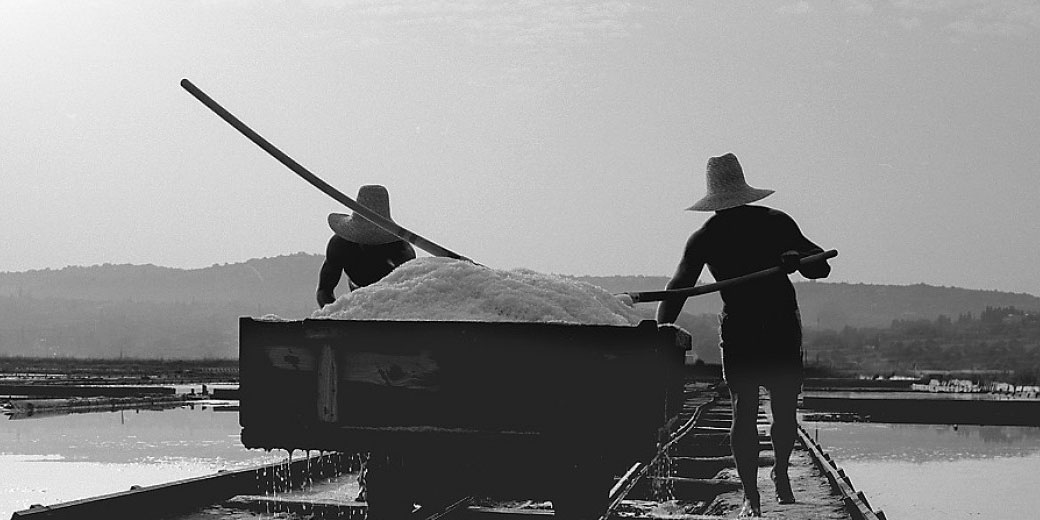
In this multitude of quality salts, Piran salt, which is produced according to tradition, which is more than 700 years old, has an extremely prominent place. The Sečovlje salt pans are the most northerly still active salt pans in the Mediterranean and one of the few salt pans in the world, where salt is produced according to centuries-old procedures that originate from at least the 14th century. Their specialty is that the salt workers grow petola at the bottom of the crystallization pools. It is a biosediment base that prevents sea mud from passing into the salt and thanks to which salt contains many microelements and minerals necessary for the human body. It is produced with completely natural crystallization, by hand and with tools and procedures according to the tradition of grandfathers and great-grandfathers.
Saltworks has distinctly shaped the cultural landscape, i.e. areas marked by the work of human hands.
Park
The Sečoveljska solina landscape park with an area of approximately 750 ha lies in the extreme southwestern part of Slovenia, right next to the border with the Republic of Croatia, in the southern part of the municipality of Piran. The northern part of the park, where active salt production still takes place, is called Lera. It is separated from the southern part of the park, called Fontanigge, by the bed of the Drnica stream.
There are large pools on Fontaniggs, which are gradually overgrown with a characteristic salt-loving vegetation - halophytes. They are interspersed with a system of ancient embankments, most of which are mostly preserved. The former salt houses are scattered along the wider canals, which with their characteristic image co-shape the uniqueness of the salt landscape. The main freshwater vein is the Dragonja River, which flows into the sea after a 10-kilometer flow in the Sečovel Salt Flats.
In Fontanigga, salt production was abandoned in the 1960s, and salt is still produced in a way that dates back to the 14th century as part of the saltworks museum. Each salt field here represented an independent salt pan, with its own pools for condensing sea water and crystallization. Despite the fact that salt production in the Fontanigge area was abandoned, large pools are still used to thicken seawater.
On Lera, however, there are salt fields intended for the crystallization of salt, separated from the fields for thickening of sea water (pools for thickening water). The difference between the two methods of salt production therefore lies in the technological process, which is linked to the preparation of brine, the collection and storage of salt, and various work tools. The common characteristic of both salt pans is that salt pans grow petola at the bottom of the salt fields, a special type of biosediment that prevents the passage of sea mud into the salt and prevents the installation of individual ions in salt.
Location
Seča 115, 6320 Portorož, Slovenija