


- Website
- +386 (0)1 836 11 04
- Get directions
- prev
- next
About
The mission of handicrafts is a permanent concern for the production, preservation, research, display, education, dismantling and popularization of domestic and artistic crafts. The activity of handicrafts is not limited to a specific geographical area. It also carries out its activity from the first paragraph of this article outside the borders of the Republic of Slovenia.
Dry edge
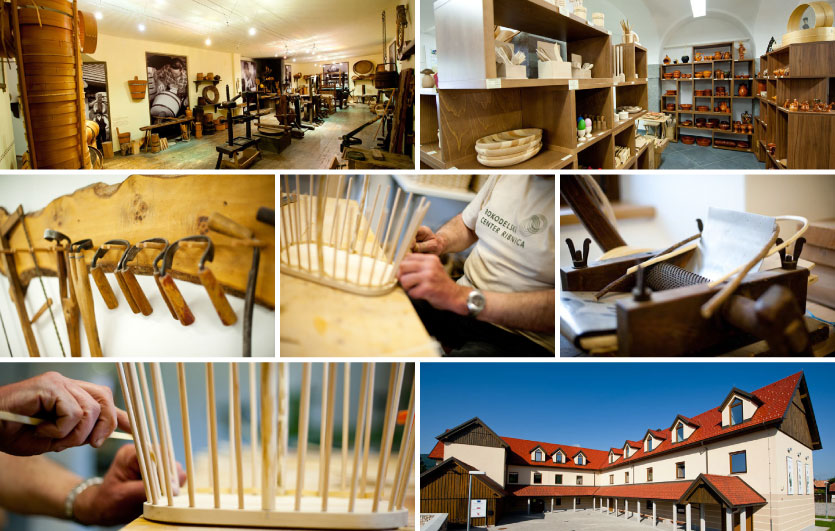
In addition to other types of domestic crafts or handicrafts, the so-called i. The dry goods area was the most developed and also preserved the production of dry goods. These are various wood products used in the household, in farm chores and as souvenirs. In addition to the special way of life, it also represented a special source of income for the inhabitants of the countryside. The inhabitants of Ribniška dolina not only made objects, but also traded with them. In 1492, Emperor Frederick III. issued the so-called peddler's patent, a privilege, with which he granted Kočev and Ribnik farmers the right to free trade in grain, linen and home-made goods in the lands of their empire. With this, the products or "edge" crossed the house threshold. A traveling canon and canon trade developed on the shoulders, later with horses and wagons, with a bicycle and a car. On the basis of adaptation to natural conditions, dry farming was divided into industries according to the type of wood used for an individual object, according to the proximity of the forest and according to house tradition. Dry goods are still at home in Ribnica and the surrounding area today, and among the dry goods we find real masters of wood design.
Pottery
This craft provided bread to the inhabitants of the southern part of the Ribniška valley, where there are deposits of clay. Valvasor reports in Slava Vojvodina Kranjska from 1689 that there are over 80 houses in Dolenja vas, where they are engaged in the production of clay products. Pottery was also dealt with in the villages of Prigorica, Nemška vas, Rakitnica and Blata. Even the potters had to be able to cash in on their products. Pots, slats, potholes, bowls, "whistles that whistle in the ass" and chirps were sold all over Slavonia, Vojvodina, Dalmatia, Friuli and Slovenia. Today, the pottery tradition is preserved and upgraded by four more families and one ceramist.
Permanent Exhibition: In step with the times
With the help of division into eleven industries, the modern production of dry goods is exhibited, which is designed on the basis of the geographical indication "Ribniška dry goods". With this exhibition, the Handicraft Center aims to promote the production of high-quality, modernly designed products with the aim of greater marketing of products and promotion of manufacturers. You can also see masterpieces of treated wood (wooden headgear, strings...) and products of traditional pond pottery and modern ceramics. Since it is not a classic museum presentation, we are accompanied through the exhibition by the mischievousness of Miha Mateta.
Workshops for children
Handicraft workshops are intended for children who are curious and creative, or who would like to become one. The topic of the workshops relates to the cultural heritage of dry goods and pottery, and children make a useful item from natural materials. The workshops are suitable for children from the age of 6, younger people should come accompanied by an adult.
Adult workshops
Workshops for adults are intended for everyone who wants to enrich their knowledge of manual skills, spend quality free time and, under professional mentoring, make a useful product related to a certain season or holiday. The workshops take place in the afternoon and usually last 1-2 hours.
hinges
Courses for adults are aimed at learning about the basic procedures of handicraft knowledge about the production of dry goods and pottery and other handicraft skills.
A knitting and pottery school
Both schools are continuous education, which takes place within the framework of the Written Heritage and Handicraft Creativity project and lasts 3 years. The beginning of education is possible in the first year and then in stages of acquiring knowledge about knitting and pottery. After three years, acquire basic skills that allow you to take the exam for the national professional qualification (NPK) potter or plexus.
Working time
Monday - Friday: 9:00 - 17:00
Saturday: 9:00 - 13:00
Sundays by arrangement
Holidays: Closed
Location
Cesta na Ugar 6, 1310 Ribnica, Slovenija