


- Website
- +386 (0)2 743 11 10
- Get directions
- prev
- next
About
About Us
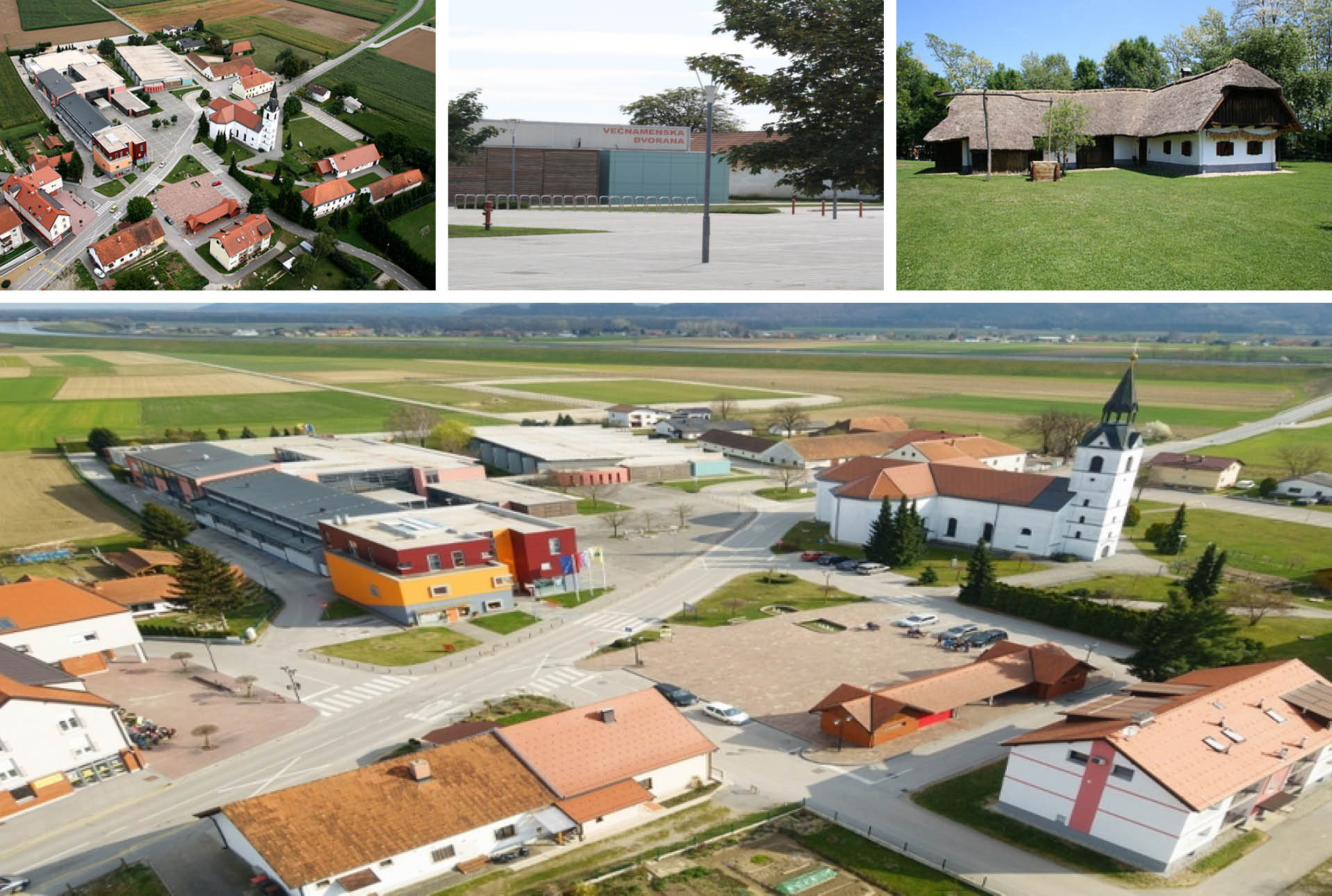
The municipality of Gorišnica comprises settlements in the middle of Ptujsko polje, which lie from 200 m to 2 km from the Ptuj-Ormož regional road, on both sides of the Canal for the Formin HE and the flood zone of the Pesnica River. The fertile plain between the settlements is dominated by cultivated areas with fields and meadows, and in between there are small forest islands. A noble vine thrives towards the foothills and on the southern slopes of Slovenske gorice. The municipality includes the villages of Cunkovci, Formin, Gajevci, Gorišnica, Mala vas, Moškanjci, Muretinci, Placerovci, Tibolci, Zagojiči and Zamušani. The center of the municipality is Gorišnica, a clustered settlement on Ptujské polje, which spreads on both sides of the Ptuj-Ormož regional road. Today's center is designed around the parish church of St. Marjete from the 14th century (first mentioned in 1391), which was restored in the 19th century neo-Romanesque.
Dominka's homestead
The municipality of Gorišnica boasts a wonderful farmhouse - Dominko's homestead. According to the experts of the Institute for the Protection of the Heritage of Slovenia, it is considered the oldest completely preserved house, built in the Pannonian style. She is over three hundred years old. Architecturally, it belongs to the typical Pannonian houses, built in a corner so that the residential and commercial parts meet in the shape of the letter L. The building is cypress - built of wooden logs, surrounded by clay plaster and whitewashed with lime. Small windows with shutters are protected by iron crosses. The roof, a tufted gable roof, is covered with straw. Inside, there is a beautiful "black kitchen", a house, a house (room), a storeroom, a hall, a farm - a barn, a stable, a cellar, a convenient workshop, a litter box and a grain cellar. Everything is equipped with original original equipment, such as the last resident left. All this reflects the former way of life.
The last resident, Katarina Nemec, carefully maintained the house until her death in 1990 with the help of her daughter Angela. After her death, she remained uninhabited. It began to visibly deteriorate, which was closely monitored by the art teacher at the primary school in Gorišnica, Boštjan Rihtar. With the students, he undertook a research paper on the house. They managed to arouse public interest. Finally, the municipality of Gorišnica, with the great support of the then mayor Slavko Visenjak, encouraged the locals and the financial assistance of the Ministry of Culture, bought the homestead from the owner in 1997. The house soon began to be restored under the expert guidance of ethnologist Jelka Skalicky from the Maribor unit of the Institute for the Protection of Cultural Heritage of Slovenia, who was greatly helped by the local Stanko Amejčič. In two years, the homestead got a fresh look and today it means a kind of cultural monument. Even the surroundings of the house seem to want to convince people that they have stepped into another time - with a typical Pannonian well, a piggery, a piggery, an apiary covered with a straw, a cornfield, a carefully cultivated field... Dominkova's house - The home of the once small farmer "Želar" thus acquired a new meaning and content, and together with the environment, it is unique in the Slovenian area. It is an open-air museum and attracts mainly school youth to visit. Here, children relive the former life of the little farmer in this area directly with the vivid narration of the guides. The house is not only intended for tours, but various events related to the seasons, holidays and customs take place here throughout the year.
Location
Gorišnica 83a, 2272 Gorišnica, Slovenija